



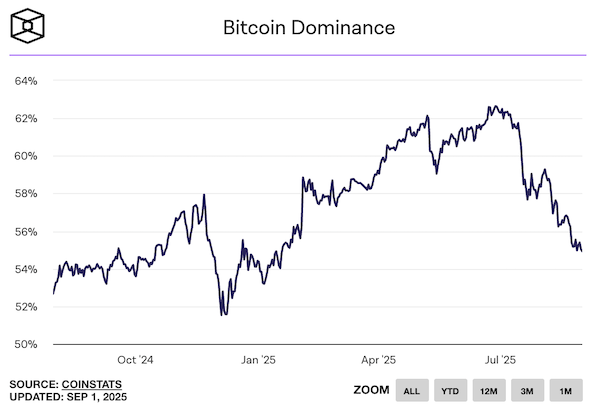
Bitcoin ‘s dominance has fallen sharply in recent weeks, from a peak of 62% to around 55%, signalling a shift in investor behaviour and a potential shift towards a new altseason. This indicator, often overlooked by less experienced traders, is in fact one of the most refined signals for capturing cyclical shifts in crypto market sentiment in advance. Indeed, dominance measures Bitcoin’s weighting relative to the total crypto market capitalisation, highlighting whether investors are seeking refuge in the king of cryptos or instead targeting riskier assets.
The graph updated on 1 September 2025 clearly shows a reversal from previous months, when Bitcoin seemed to strongly regain its dominance, probably in the wake of macroeconomic fears and regulatory uncertainties. But the recent decline in dominance suggests a readjustment: capital is slowly turning towards altcoins, with Ethereum and Solana at the forefront. The ‘store of value’ narrative is thus giving way to that of technological innovation and exponential growth potential.
Among the key players in this rotation are Digital Asset Treasuries (DAT), structures created to raise funds and invest in crypto assets through listed vehicles. These initiatives, driven by institutional capital, are attracting the attention of large investors seeking exposure to emerging protocols, but with a regulated structure. It is thanks to these instruments that Ethereum and Solana are benefiting from a steady flow of interest, often from the same funds that had chosen caution in the previous cycle by taking refuge only in Bitcoin.
However, if the past teaches us anything, it is that dominance can also go much lower: in the 2021-2022 cycle it had plummeted below 40 per cent, opening the door to vertical rallies by many altcoins. Today we are in a middle ground, in an unstable equilibrium that could herald an acceleration towards a decidedly more altcoin-driven market. The current level of 55% is a signal not to be underestimated, because it implies that interest in riskier assets is already maturing, though without having yet turned into speculative euphoria.
The crucial question now will be whether this renewed interest in altcoins will turn into real demand in the spot market or remain confined to the more ephemeral world of derivatives. With the arrival of ETFs and regulated funds allowing the direct purchase of tokens, the real question to ask is: who will control the liquidity spigot? If the inflow of capital is direct and continuous, we could be looking at a genuine rededication of the potential of altcoins.


