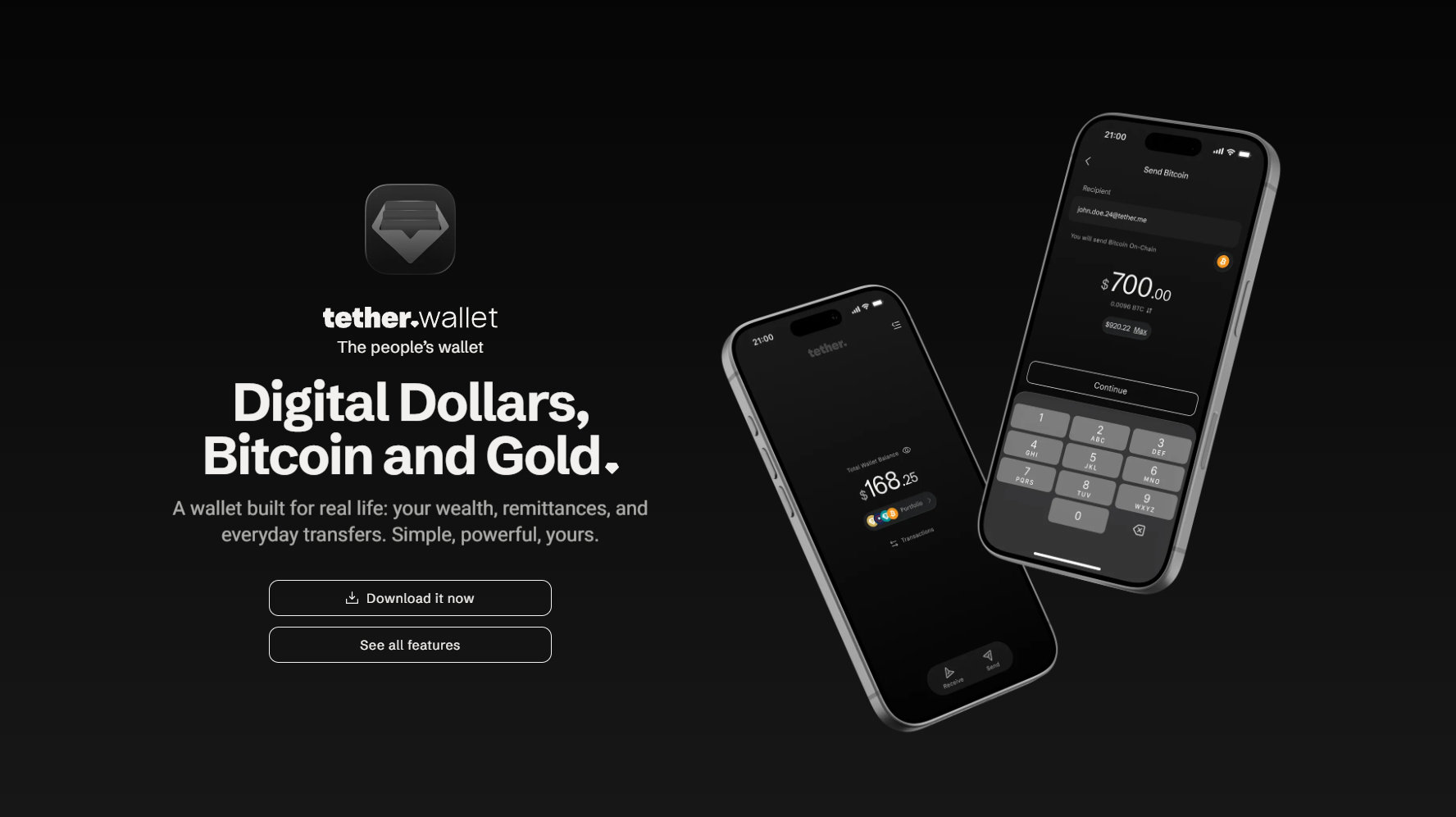
For years, tether has been the great invisible infrastructure of the crypto market: the engine of payments, liquidity and global settlement, but hardly ever the end product in the hands of the user. With the launch of tether.wallet, announced on 14 April 2026, this balance changes dramatically. The USD₮ issuer has decided to move down from the backend to the frontend, offering a self-custody wallet that brings its global financial network directly to the public, with the stated ambition of serving billions of people excluded from traditional banking channels.
The strongest figure is the one Tether uses to tell its scale: by March 2026, its technology would be used by more than 570 million people worldwide, with tens of millions of new wallets added every quarter. Even if one were to read that number with caution, the strategic message is crystal clear: Tether no longer wants to be just the digital dollar that runs under the bonnet of exchanges, but the brand that directly presides over the everyday user experience. It is a move that also touches Bitcoin and Ethereum, because the wallet already starts with support for USD₮ on Ethereum, Polygon, Plasma and Arbitrum, for XAU₮ on the same networks, for US₮ on Ethereum and for Bitcoin both on-chain and via the Lightning Network.
The real commercial promise of tether.wallet is extreme simplification. Users can send funds with a readable identifier like nome@tether.me instead of copying long and fragile alphanumeric strings, while fees are paid directly into the transferred asset, avoiding the classic friction of separate gas tokens that has slowed mainstream adoption of crypto applications for years. Translated from the language of marketing to the language of the market: Tether is trying to remove the blockchain from precisely those obstacles that make it powerful for insiders but still hostile for the general public.
Then there is the other element, perhaps the most important in an era when custody is back at the centre of the debate: the app is avowedly self-custodial. Transactions are signed locally on the user’s device, while private keys and seed phrases remain under the user’s exclusive control. It is a choice that brings tether.wallet closer to the original philosophy of the industry and that, at least on paper, distinguishes the product from custodial solutions that are more convenient but more vulnerable to blocks, restrictions or counterparts. In practice, Tether tries to occupy a delicate space: to simplify without becoming a bank.
The wallet is also built on a technological foundation already in place. Tether builds it on top of its own Wallet Development Kit, the open source WDK, presented as a multi-chain and self-custodial toolkit that can be used not only by people but also by machines and AI agents. In the official documentation, the project is described as an infrastructure designed for mobile, desktop, server and embedded devices, with core libraries, UI templates and public repositories for developers. This detail matters more than it seems, because it tells us that tether.wallet is not just an app: it is the consumer interface of a broader ecosystem that Tether envisions as the operating standard for digital transactions between humans, software and automata.
Paolo Ardoino has called tether.wallet
the people’s wallet
Sending value should be as simple as sending a message. It is a brilliant formula, but also a fierce gamble. Because the moment Tether puts its name at the forefront in front of the end user, it will no longer be able to limit itself to being the hidden binary of crypto finance: it will have to prove that it knows how to build an everyday product that is as intuitive and reliable as the network that made it a giant. If it succeeds, it will not only have launched a wallet. It will have transformed USDT from a market infrastructure to a global monetary operating system. And by then, whether purists like it or not, the people will have already voted with their thumbs on the screen.