If there is one thing the crypto market continues to do better than anyone else, it is turn every technological novelty into a financial arena in a matter of days. In January 2026, this dynamic exploded in four different directions, seemingly unconnected but in fact daughters of the same matrix: attention, liquidity and infrastructure. On the one hand, the hype of artificial intelligence ‘packaged’ in tokens on Solana; on the other, the rise of predictive markets as a new real-time media; in the middle, the concrete promise of spending digital assets in everyday life; in the background, Ethereum cutting fees to historic lows but discovering that efficiency, when it costs too little, can attract even the worst incentives. Within this framework, Bitcoin remains the psychological barometer of the entire sector, but it is no longer the sole centre of gravity: the real competition is played out on usability, brand and value capture mechanisms.
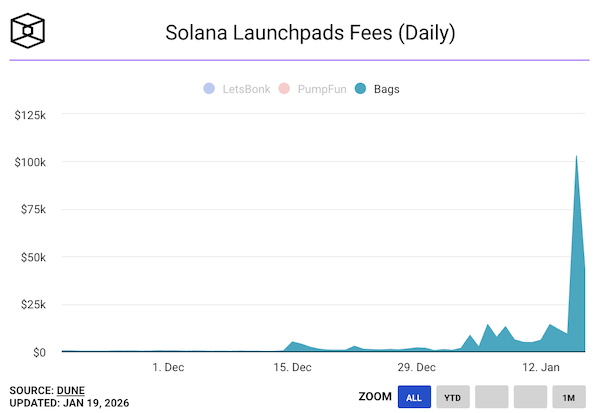
The first sign comes from Solana and the Bags phenomenon: launch fees shot up over $100,000 in a single day, an outsized increase compared to the previous average, and a number of ‘graded’ tokens that on some days would have surpassed even iconic platforms of the memecoin economy such as Pump.fun. The reason is not a sudden collective epiphany about tokenomics, but a classic feedback loop: a viral idea among developers, in this case the push around Anthropic’s Claude Code, generates trending repositories; speculators turn them into tokens; tokens attract more attention; attention draws new launches. The interesting detail is the concept of ‘claiming’: in some cases the real developer of the AI project enters the game, claims the token and redirects the trading fees to his own wallet, transforming a memetic bet into a proto-community economy. This is where the mechanism becomes ambiguous: if the best teams really start to build around these tokens, the meta becomes legitimate; if it is limited to a game of musical chairs, volatility will do what it has always done. The $GAS case is the perfect example of how thin the line is: hype, violent pump, then a public distancing of the developer and collapse. In other words: in 2026 it is not enough to ‘tokenize’ AI, we need a credible pact between developer and market, otherwise it is just noise disguised as innovation.
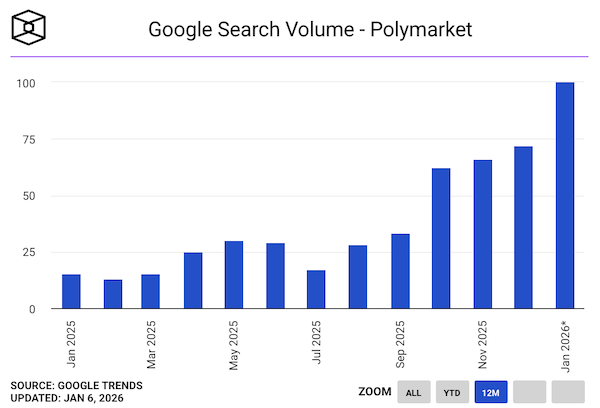
The second signal is more subtle but perhaps more important: Polymarket is not only growing as a platform, it is becoming a verb. Search interest on Google for ‘Polymarket’ hits 100, an all-time high, even surpassing the peaks of the 2024 election period, when the election-related volume exploded. The most revealing fact, however, is the divergence between brand and category: while ‘Polymarket’ rises, the generic term ‘predictive markets’ falls. It is the same dynamic seen with Google in the early 2000s, when ‘Google it’ mentally replaced the very idea of ‘search engine’. If this network effect consolidates, competitors (Kalshi included) no longer compete only on product, but against a cultural habit. And when an app becomes an information infrastructure, it is no longer just trading: it is a new way of measuring consensus and pricing uncertainty, often faster than polls and more ruthless than opinions.
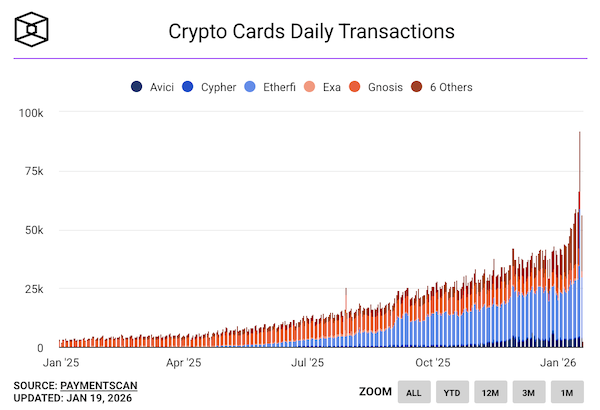
Third sign: crypto stops being just ‘investment’ and goes back to being ‘money’ at the point of sale. Cryptocurrency-based cards are seeing a 22-fold growth in daily transactions since December 2024, reaching close to 60,000 transactions by mid-January 2026, with nearly $4 million in daily volume. The model is simple and, for that very reason, powerful: automatic conversion to fiat at the time of payment, Visa or Mastercard, minimal friction. It is the missing bridge between wallet and supermarket. Unsurprisingly, the market is experimenting: Etherfi dominates a significant share of transactions, but the competition includes Metamask, Gnosis, Solayer and others, each with different incentives and revenue models. The most ‘2026’ part, however, is the idea of making the balance work while it remains spendable, by pegging it to DeFi returns or onchain mechanisms. The question here is not whether it will work technically: it is whether it will hold up economically when the promotional subsidies end and only margin sustainability remains.
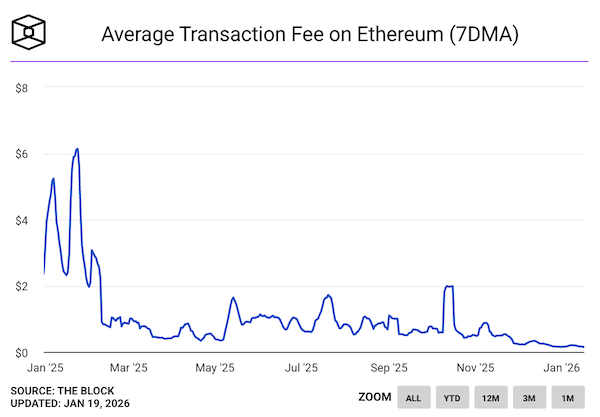
Finally, the fourth signal concerns Ethereum‘s ‘poison gas’: average fees dropped to 16 cents, levels not seen since 2020, while transactions remain above 2 million per day. This sounds like a win for adoption, and in part it is, thanks in part to the role of Layer 2s and BLOBs shifting load and reducing pressure on the base layer. But there is a downside: when blocking space becomes cheap, spam also becomes a business model. Recent growth includes address poisoning attacks, favoured by low costs, with total losses reported over $740,000. The paradox is clear: the more efficient Ethereum becomes, the more it has to raise the security bar at the level of UX, wallet and user education. And in the meantime, an uncomfortable question arises about the sustainability of the ‘peaceful ultrablockspace’: if fees remain depressed for too long, the economic mechanisms that should make ETH structurally attractive also change tone.
Four stories, one moral: in 2026 crypto does not move ‘because it does’, it moves where attention can become flow, and where flow can become habit. Bitcoin remains the cover, but the real paper is written elsewhere: in the launchpads that promise perpetual royalties, the platforms that sell probabilities, the cards that spend returns, and the low fees that make the network more accessible… even to predators. If the market wants to be adult, now is the time to prove it: not with a new ATH, but with a system that doesn’t collapse when everyone stops believing and starts using.