



Competition in the blockchain sector is fiercer than ever, with new projects trying to solve the scalability and cost limitations of existing networks. Monad is one of the most anticipated Layer-1 blockchains of the moment, with a clear goal: to surpass Ethereum in efficiency without sacrificing EVM compatibility.
Raising a record $253m – including $225m in the Series A round alone – Monad has just launched its testnet, introducing an innovative architecture based on parallel execution and an advanced consensus mechanism called Monad BFT.
But what exactly is Monad and how could it change the future of blockchain?
Monad is an Ethereum-compatible blockchain, but with a speed and scalability comparable to Solana. Thanks to the parallel execution of transactions, it can process up to 10,000 TPS (transactions per second), with a finalisation time of 1 second.
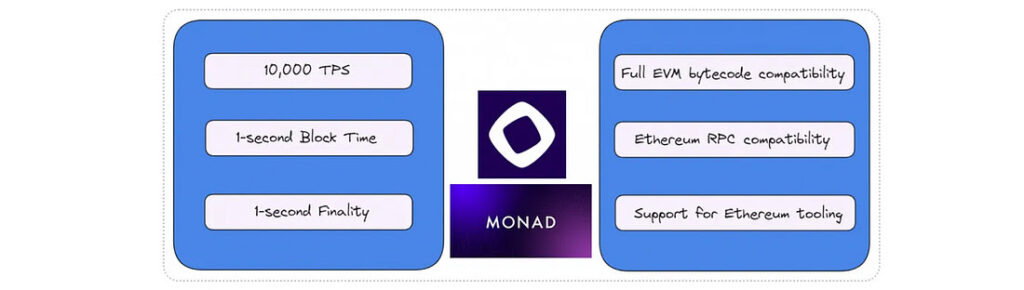
Unlike Ethereum and its Layer-2s (Arbitrum, Optimism, Base), which still suffer from congestion, Monad optimises performance with four key innovations:
- Parallel execution – Transactions are processed simultaneously, eliminating bottlenecks.
- Parallel database – Data is read and written faster, improving network efficiency.
- Asynchronous execution – Reduces the waiting time between the transmission of a transaction and its confirmation.
- Monad BFT (Byzantine Fault Tolerance) – A scalable consensus mechanism that allows thousands of nodes to operate without sacrificing decentralisation.
These features make Monad one of the most technologically advanced blockchains, with a structure capable of supporting decentralised DeFi, NFT, gaming and AI applications.
Who is already building on Monad’s testnet?
Although still in the testnet phase, Monad has already attracted several key projects and protocols: from MagicEden (NFT marketplace) to Uniswap (decentralised DEX) to LayerZero (cross-chain interoperability protocol).
Immediate integration with Backpack Wallet and Phantom Wallet is a further strength, facilitating user adoption.
Monad Testnet is live.
Try it out here: https://t.co/QoJwPxRBTC pic.twitter.com/Inzvzd5Xl1
– Monad ⨀ (@monad_xyz) February 19, 2025
Can Monad compete with Ethereum, Solana and the L2s?
The blockchain market is crowded with projects trying to solve scalability problems, but only a few manage to emerge. Ethereum continues to dominate in terms of TVL (Total Value Locked), with over $60 billion, while Solana has consolidated its position in DeFi and NFT.
Monad will have to prove it can attract developers and users by building a solid ecosystem and concrete use cases. Its compatibility with EVM is a big advantage, but will it be enough to undermine the established alternatives? We will see, in the meantime the expectation is very high and the launch of Monad’s testnet is an important step for the future of high-performance blockchain. If it delivers on its promises, it could become a major alternative for DeFi and Web3 developers.


