
Google has just raised the bar again, and this time in a way that is hard to ignore. With the launch of Gemini 3.1 Pro, the Mountain View team is not presenting a cosmetic update to its flagship model, but what the official blog unabashedly calls ‘the improved core intelligence that makes scientific and engineering breakthroughs possible’. The release is in preview mode starting today, distributed simultaneously across all major channels: Gemini API via Google AI Studio, Google Antigravity agent platform, Android Studio, Vertex AI for enterprise, and for consumers via the Gemini app and NotebookLM. Those paying for a Google AI Pro or Ultra plan already have direct access with high limits. The speed of deployment is a signal in itself: Google does not want to wait to polish the model in the lab while competitors gain market share.
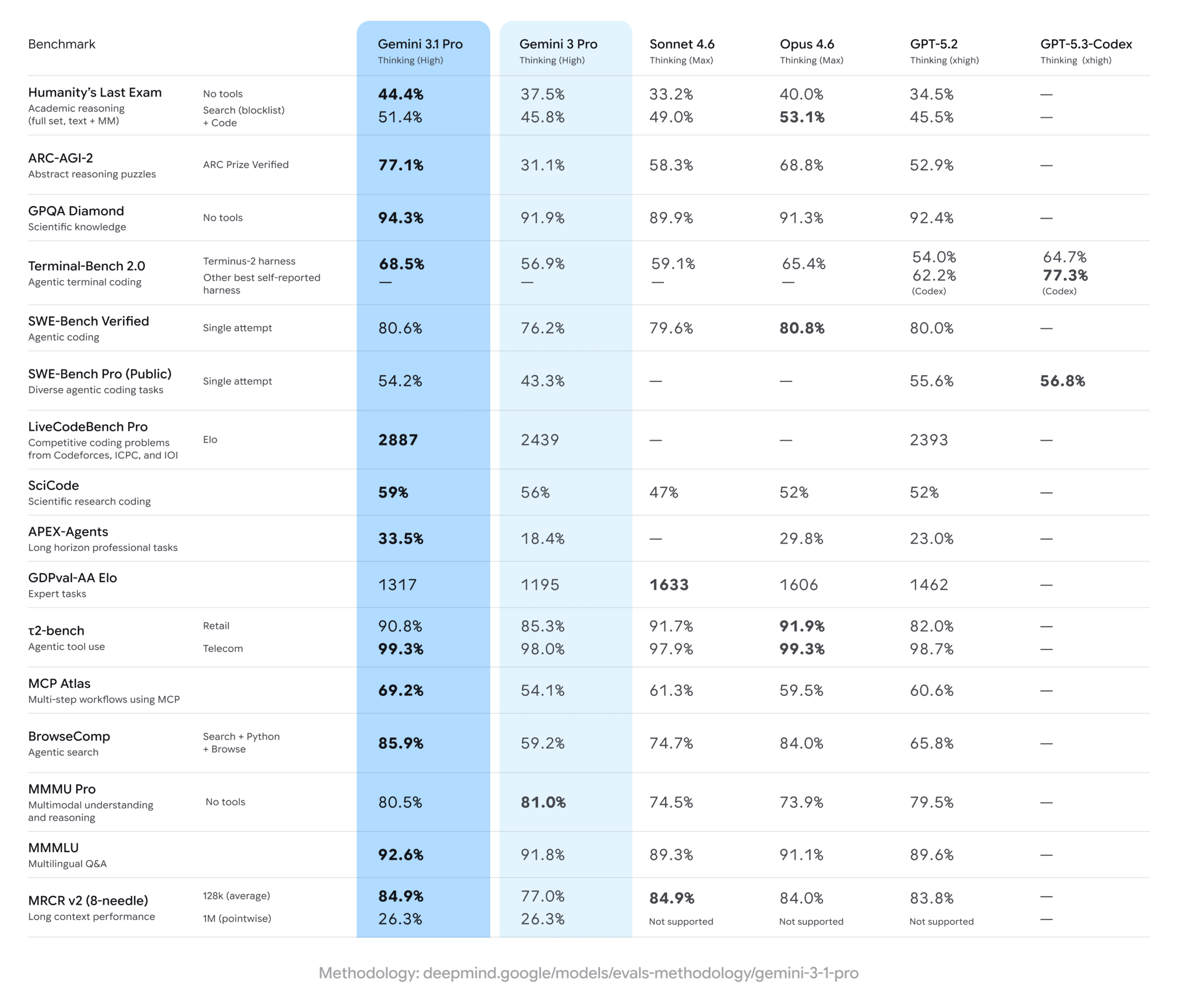
The number that has already sparked debate in the community is 77.1% on ARC-AGI-2, the benchmark designed precisely to measure the ability to solve completely new logic patterns without the model ever having seen them during training. It is more than double the Gemini 3 Pro score on the same metric, and this progression alone tells the nature of the qualitative leap: it is not a matter of accumulated knowledge, but of genuinely adaptive reasoning in the face of the unknown. To put it in context: ARC-AGI-2 is the same benchmark that François Chollet designed as a ‘measure of general intelligence’, and on which previous models systematically stumbled. A 77.1% does not mean AGI achieved, but it does mean that the distance has shortened in a visible and measurable way.
But Gemini 3.1 Pro also stands out for the quality of its practical applications, which Google chose to show with concrete examples rather than abstract benchmark slides. The model is able to generate animated SVGs directly from a textual prompt: not rasterised images, but pure vector code, scalable to any resolution and with minimal file size. Even more impressive is the demonstration of the aerospace dashboard: starting from scratch, 3.1 Pro configured a public telemetry stream to display the orbit of the International Space Station in real time, linking complex APIs to a working graphical interface. This is not an isolated technical show of strength: it is a demonstration that the model can reason about complex, real systems, not just stylised problems.
On the creative front, Google published an example mixing literature and code: 3.1 Pro was instructed to build a modern personal portfolio for Emily Brontë, the author of ‘Wuthering Heights’. The model did not simply summarise the novel, but reasoned about the narrative atmosphere to translate it into a contemporary interface that captures its visual essence. It is the kind of output that until a few months ago required an art director, a frontend developer and a few hours of briefing. All this comes as an update to the core engine that already powers Deep Think, the model released last week for scientific and research challenges: 3.1 Pro is, as Google puts it, ‘the intelligence that makes those advances possible’.
The release is still in preview, with general availability announced as ‘imminent’, and Google specifies that improvements on ambitious agent workflows are underway before the final launch. But the strategic message is already in the air: after months in which the public debate saw Gemini as perennially trailing behind OpenAI and Anthropic, Google is choosing to return to the forefront with verifiable numbers and demos that don’t need much commentary.
In 2026, artificial intelligence is no longer measured in how many questions it answers, but in how many things it builds from scratch without you having to know how to ask it. And on that terrain, Gemini 3.1 Pro has just planted a flag that will not go unnoticed.