




On Friday, the cryptocurrency market experienced the most severe wave of liquidations in its recent history, with estimates of between $18 billion and over $20 billion wiped out in less than 24 hours, following a sell-off triggered by President Donald Trump’s newly announced tariffs on China and amplified by the systemic risk of leverage on perpetual futures. The backdrop was that of a rapid correction on leading assets such as Bitcoin and Ethereum, which accelerated to the downside as forced closures of long positions turned into sell orders on the market, generating additional pressure on already depleted order books. Figures reported by several trackers indicate a number of traders liquidated in the range of one million, with extreme concentration in the early hours of the move, and with estimates that may be conservative due to reporting limits on some top-tier exchanges.
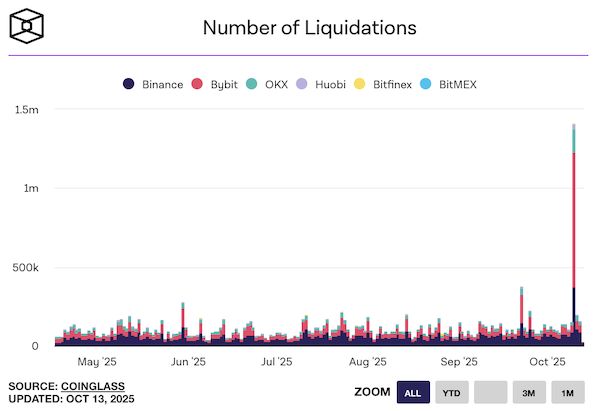
The link between the macro event and the micro-structural dynamics of the crypto market was stark: the announcement of additional 100% tariffs on Chinese imports shifted global sentiment towards risk, reflecting on the Nasdaq and S&P 500 and deflating in the digital sector as a rush on highly leveraged perp contracts. The sequence was the usual, but with unprecedented magnitude: initial price declines, eroded margins, automatic liquidations, further market sell-offs, slippage, new margin call thresholds hit and a self-reinforcing cycle that dug bottom with a speed that discretionary traders simply cannot match. Against this backdrop, Bitcoin posted a triple-digit intraday drawdown of thousands of dollars off weekly highs, while Ethereum extended the bearish beta typical of deleveraging phases, while offering key signals on remaining market depth.
One element that surprised insiders was theasymmetry between the fragility of centralised leverage and the robustness demonstrated by DeFi’s infrastructure under extreme stress. The Hyperliquid perpetuals platform handled record volumes and liquidations while maintaining operations, with thousands of wallets affected but no critical downtime, while auto-deleveraging and vault mechanisms functioned as safety valves of last resort. Lending protocols like Aave also traversed the vortex with solid operational performance, liquidating collateral deterministically and without human intervention, a sign of maturity that in other eras of on-chain congestion would have been unthinkable.
The grey area of definitive figures and accountability remains: several desks suggest that the 20 billion is a base and not a ceiling, as some exchanges report only a fraction of liquidation orders per second, making the true extent of the domino opaque. It is plausible that positions of institutional players or market makers acted as amplifiers in a market with relative liquidity, a combination that turns a macro trigger into a micro-structural landslide, especially when spreads widen and funding becomes pro-cyclical. For traders using cross-margin, the bill has been steep: spot collateral pledged to support perp leverage has evaporated along with the positions, reminding us that tail risk does not discount even major assets like Bitcoin and Ethereum.
If there is a lesson here, it is that the crypto market remains a high-frequency emotional and mechanical ecosystem, where one sentence of trade policy can move more leverage than a thousand whitepapers, but where DeFi has begun to behave as a reliable infrastructure even when the sea is force 9: and in that din, those who know how to swim against the tide don’t look for the bottom, they build it.


