




Spot ETFs on Bitcoin have broken a new psychological and financial barrier: $109 billion in assets under management. A milestone that comes not by chance, but as a result of a structural and steady growth that, since their launch, has overturned the cryptocurrency investment paradigm. The rise of these regulated instruments represents the most concrete confirmation that institutional capital is finally flowing with conviction towards Bitcoin.
BlackRock’s IBIT has quickly and decisively emerged as the major player, gaining the most significant slice of the market. On 28 April, it raised $970 million in a single day, recording the highest daily inflow in three months. This is a strong and unmistakable signal: the interest in Bitcoin among institutional investors did not end with the initial euphoria, but continues to be fuelled by strategic allocation logic, not just speculation.
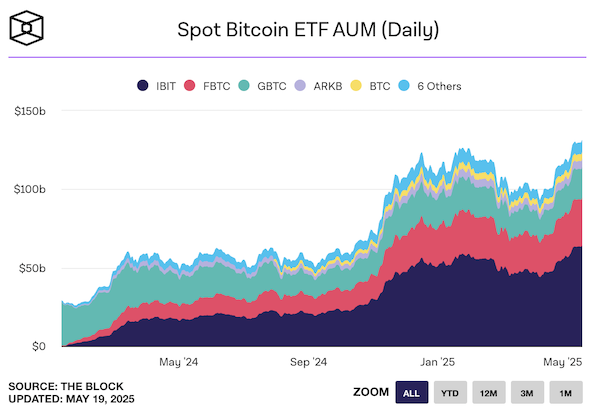
The real strength of these ETFs lies in their ability to circumvent the traditional obstacles associated with holding cryptocurrencies. Before their introduction, holding Bitcoin securely required infrastructure and technical expertise that were outside the operational logic of traditional financial institutions. ETFs have normalised access, making exposure to Bitcoin similar to exposure to any other regulated asset. And this normalisation is paying off, not only in the US but globally.
Indeed, it is not just BlackRock and the US giants. Hong Kong has firmly entered the game, and Avenir, an investment firm based in the region, has built a nearly $700 million position in Bitcoin ETFs. A figure that shows that the appetite for digital assets is now a cross-border phenomenon, no longer confined to the Anglo-Saxon world.
Even more surprising is the move by Mubadala, the Abu Dhabi sovereign wealth fund, which has allocated over $400 million in these instruments. A conservative public body betting on Bitcoin is an endorsement worth a thousand words. It is proof that the crypto asset par excellence has won over even the most rigid and traditionalist circles of global finance.
And then there is Brown University. The American academic institution has announced an almost symbolic exhibition – around $5 million – but one of enormous cultural value. When even university endowments start allocating funds to Bitcoin, it means that we are no longer in the territory of a passing fad, but at the heart of a systemic transformation.
Bitcoin is no longer the rebel asset of the cypherpunks. Today it is the new building block of global institutional allocations. And those who are still convinced that this is all just hype are perhaps simply reading the future through the wrong glasses.


