




Robinhood has just released its financial results for the second quarter of 2025, and compared to the giant Coinbase, the overall picture is decidedly more nuanced. Total revenues fell by 7.5% on a quarterly basis, but in a year-on-year perspective growth is 65%, a figure that tells of a much more solid strategic evolution than it might seem at first reading.
Looking deeper, an interesting detail emerges: while the crypto business suffered a sharp setback, with a 36% drop in revenues and 39% drop in volumes compared to the previous quarter, the other business lines – options, equities and other non-crypto products – reached all-time highs, with overall growth of 14% quarter-on-quarter. This is where Robinhood seems to want to play its most important match, consolidating its position in traditional trading, while the crypto side is temporarily sidelined.
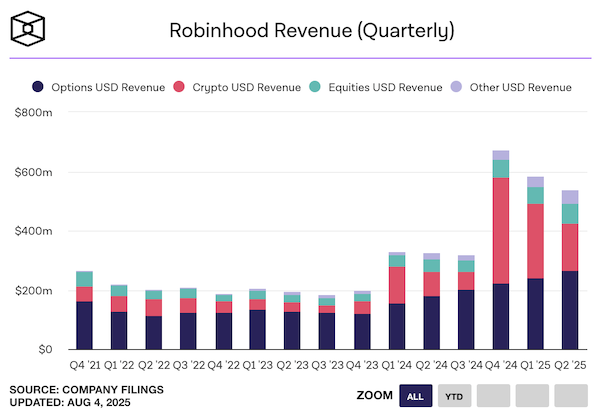
Yet despite the short-term setback, the year-on-year figures tell a different story. Crypto revenues grew by 97% and volumes by 31%, thanks to European expansion and constant work on the institutional front, including through the integration with Bitstamp. A strong signal: Robinhood is not abandoning the digital arena, indeed it is rethinking it, betting on tokenization and more sophisticated instruments such as perpetual futures.
In this context, user interest in assets such as Bitcoin and Ethereum remains central, even if enthusiasm seems to have cooled this quarter. Market volatility and the absence of strong catalysts have affected performance, but have not dented the long-term trajectory.
Robinhood has shown that it can adapt quickly, pushing on what works and redesigning what is lame. The message is clear: crypto revenues can plummet as much as 36% in a quarter, but if you’re setting up the right infrastructure, the real rally starts when others stop.


