Wan-Animate is the latest quantum leap in video AI: a unified framework that animates a character from a reference image and video, accurately replicating body movements and facial expressions, or directly substituting an in-scene subject with a visual integration so consistent it looks native to the original footage. Built on the Wan (I2V) family, the model elegantly separates ‘reference conditions’ and ‘generation regions’, normalising inputs and controls into a common symbolic representation that allows for both animation and replacement modes without distributional tearing. The result is fine and predictable control, with a fidelity that pushes the state of the art towards increasingly cinematic and controllable productions.
The technical wizardry rests on two pillars of control: for the body, Wan-Animate adopts spatially aligned skeletal signals injected into early latents to robustly transfer poses and kinematics; for the face, it uses implicit features extracted from reference frames, converted into latent vectors and temporally synchronised to preserve micro-expressions and subtle dynamics without confusing identity and mimicry. This mixed architecture, skeleton for posture, facial embeddings for expressiveness, allows maintaining frame-to-frame stability, reducing jitter and drift (small unpredictable tremors), and paving the way for credible performances even in complex contexts.
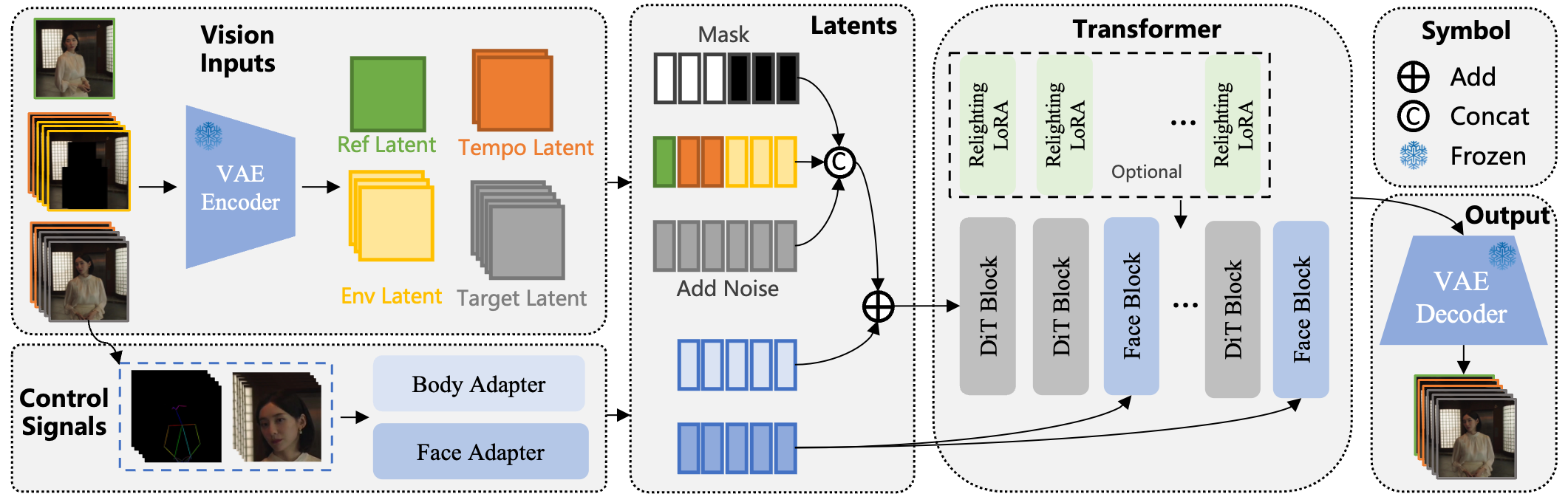
When character replacement comes into play, the difference is made by theauxiliary Relighting LoRA: a module trained to apply lighting and colour tones to the host environment, while preserving the consistency of appearance of the replaced subject. In practice, it is not just compositing: it is perceptual fusion, with light, shadow and colour science matching that masks the artefacts typical of traditional face/body swap pipelines. According to the authors, the system achieves state-of-the-art performance and will be open-source in weights and code, a strong signal for the ecosystem that is already moving forward with integrations in local toolchains and preprocess nodes in environments such as ComfyUI.
On the operational side, the flow involves the preparation of the reference video and the character image, with preprocessing steps for segmentation, skeletal keypoints and face cropping; from there, one chooses the ‘animation’ mode to transfer the performance onto the image, or ‘replacement’ to merge the character into the scene by replacing the original. Workflows that handle resolution, batching and consistency parameters emerge in the repositories and demos, as well as support for local pipelines for those who want to run everything on-prem with FP8/BF16 weight variants and dedicated wrappers.
It’s a package that speaks to both independent creators and studios: consistent identity, temporal control and a direction on the really crucial elements for verisimilitude.