



The news on Pump.fun recounted in this article of ours, gives us a small but significant resumption of speculative activity on Solana after months of dryness. Here are the key details to better understand the nuances:
The ‘graduation rate’ is the central metric. Pump.fun works like this: each token is born on a ‘bonding curve’, a mathematical price curve. To ‘graduate’, i.e. to become a ‘serious’ token, it must reach a certain liquidity threshold and migrate to a DEX (decentralised exchange) such as Raydium. This step is considered a sign of viability: it means that enough people have bought in to push the token out of its embryonic stage. A high rate = more tokens survive and become tradable on the open market.
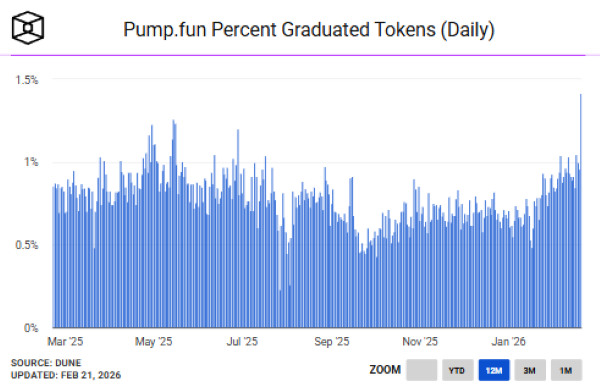
The bottom line: last Tuesday, 1.05% of launched tokens ‘graduated’, the highest value since July 2025. That sounds like a tiny percentage, but consider that thousands of tokens are launched on Pump.fun every day, the vast majority dying within hours. Having three days above 1% in a single month, for the first time in seven months, indicates that more speculators are returning to new tokens and that overall sentiment is improving.
The new Cashback Coins is the most interesting structural change. Before, creators automatically collected the trading commissions generated by their token. Now they have to choose at launch, permanently and irreversibly, between two options: keep the commissions or redistribute them entirely to traders as cashback. The basic idea is to reduce the incentive to create ‘rug pull’ tokens (where the creator launches, pumps the price and runs away with the commissions) and instead reward tokens that attract active traders through cashback. In summary: either you are a creator who believes in his project, or you give away the commissions to the community.
The acquisition of Vyper is an operational detail: Pump.fun bought this trading terminal to expand the cross-chain infrastructure, i.e. not to remain limited only to Solana but to open up to other blockchains, primarily Ethereum.
The general picture is clear: after months of a ‘risk-off’ market where nobody wanted to touch the most speculative tokens, in this February 2026 we are shown the first signs of a return of risk appetite in the lower trenches of the crypto market. It is not yet a confirmed recovery, but it is the kind of signal that usually precedes a broader speculative rotation.


