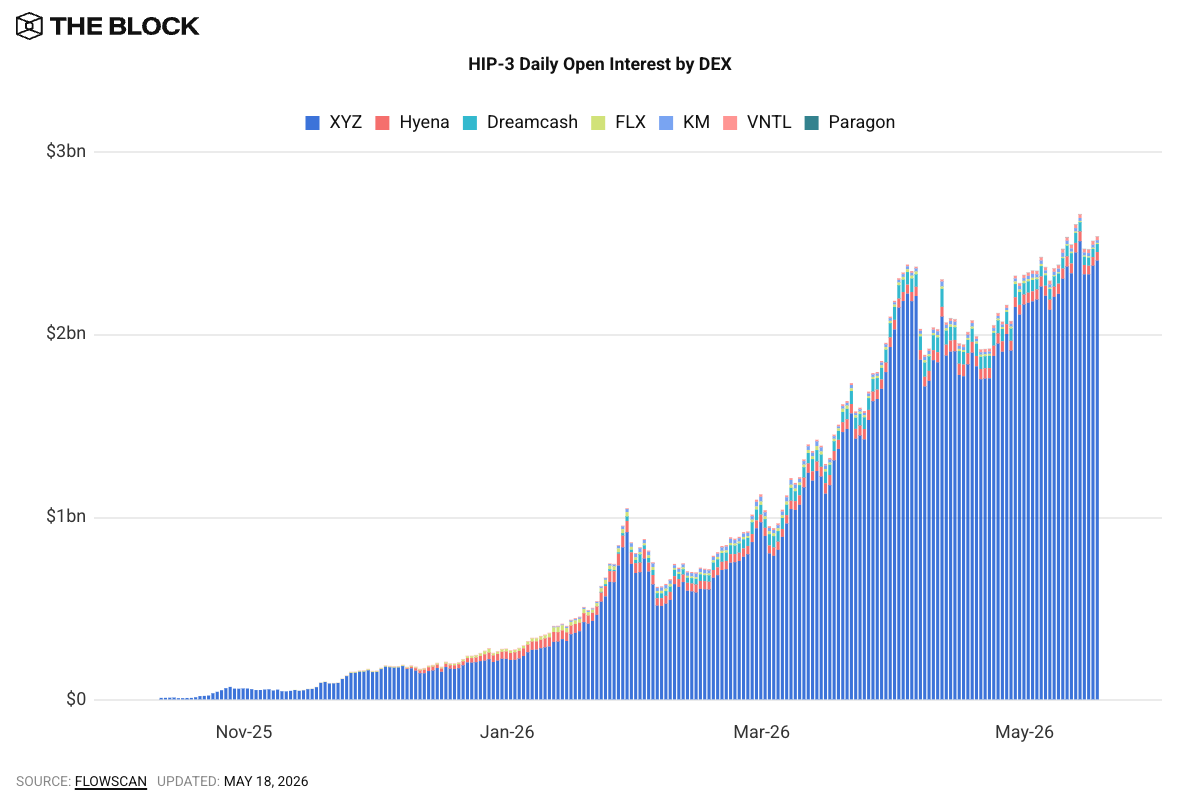
The momentum that Hyperliquid is experiencing tells more than just a platform rally: it tells how on-chain finance is trying to take over spaces that until yesterday belonged exclusively to translation desks, investment banks and private funds. In the week of 14 May, the aggregate open interest of the HIP-3 index hit an all-time high of $2.66 billion, up more than 800% since the start of the year and a share of close to 29% of Hyperliquid’s entire OI. It’s a figure that says one very simple thing: when the platform begins to host markets that lock in the pricing of traditionally opaque assets, capital comes in and does so not out of curiosity, but out of information arbitrage.
The most interesting catalyst came with the launch of trade.xyz’s IPOP product, a perpetual contract on the expected listing price of a private company prior to its IPO. The first test, the xyz:CBRS market tied to Cerebras Systems, showed something that the old grey pre-IPO markets could not offer: continuous price discovery, on-chain, without share allocation or counterparty risk on the equity itself. The contract priced the IPO with surprising precision, hovering above $280 for days, touching $320 and then converging towards $300 on the eve of the IPO, while the traditional syndicate remained much more conservative. In practice, the crypto market showed that it could read value earlier than the traditional market.
The other event that propelled Hyperliquid is the agreement with Coinbase on USDC. Coinbase becomes the treasury deployer of the stablecoin as an aligned quote asset, while Circle will handle part of the technical distribution and operational governance. The gradual transition of USDH off-stage and the strengthening of USDC as a base settlement asset are not just a technical detail: they are an acknowledgement that the most credible liquidity, on a marketplace that wants to remain global, comes when stablecoin is aligned with the institutional infrastructure. This also creates a new economic alignment, because Coinbase and Circle are no longer just external providers but actors with a direct incentive to grow the flow on the chain.
In the meantime, HYPE reacted well: the news pushed the token up about 15% on catalyst day, and the market immediately read the move as a validation not only of the product but of the model itself. The real question, however, is whether a share of the USDC float on Hyperliquid will end up falling indirectly to HYPE, perhaps through revenue sharing mechanisms, staking, or buybacks tied to the platform’s revenues. If this happens, the circuit would no longer be just trading: it would be a value capture machine between stablecoin, validation and native tokens.
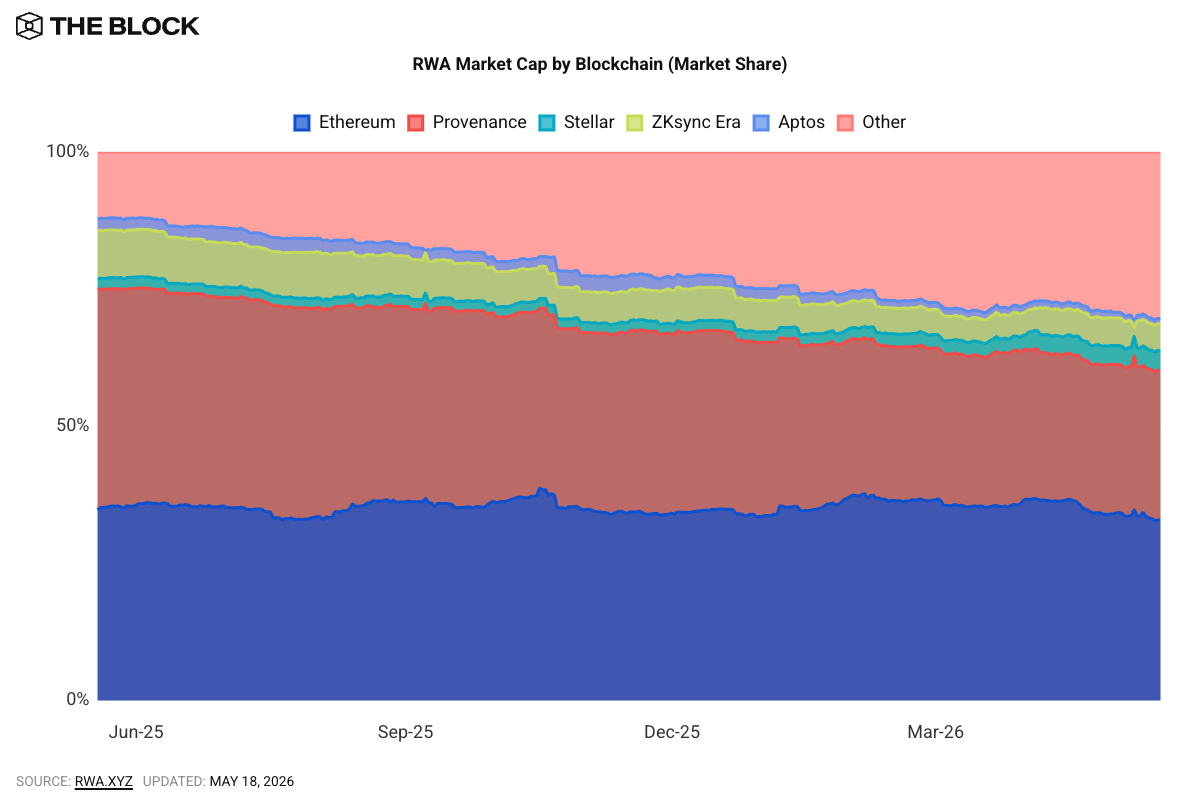
On the macro side of tokenization, the picture is equally clear. The market for real tokenized assets has surpassed $65 billion, up about 44% since the beginning of the year. Ethereum retains about a third of the market cap RWA, with Provenance at 27% and fragmentation leaving room for BNB Chain, XRP Ledger and Solana. It is a market still without a definitive winner, but with a direction that is now irreversible: those offering compliance, payment finality and competitive costs become the de facto standard. In this sense, the race is not only technological, it is industrial.
And it is here that the connection with Bitcoin becomes almost philosophical: while the king of cryptos remains the benchmark of scarcity, the new terrain of conquest is the ability to transform every asset class into a liquid, regulated and tradable digital stream 24 hours a day. Whoever figures out how to combine price discovery, stablecoin and tokenization first will not only have a stronger chain: they will have the spigot of the next financial infrastructure. And when that spigot opens, the old world always discovers too late that it is already lagging behind.