
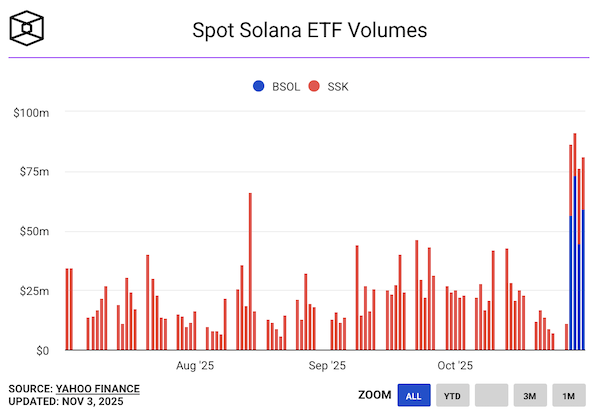
Solana’s exchange-traded products market welcomed a new heavyweight on 28 October with the launch of Bitwise’s BSOL, a staking-enabled ETF that has rapidly dominated the sector. BSOL recorded the highest launch volume of any ETF in 2025, marking the second consecutive year that a crypto ETF has achieved this accolade, following last year’s Bitcoin ETF launches led by BlackRock’s IBIT. After the first week of trading, BSOL has assets under management of about $400 million, quickly surpassing Rex-Osprey’s SSK at $370 million. The ETF’s structure provides direct exposure to Solana, with an average annual return of 7 per cent for holders and a management fee of 0.20 per cent, with a promotional fee of 0 per cent on the first billion assets invested for three months.
Staking is conducted through Helius Labs, a leading provider of RPCs and APIs for the Solana network. Bitwise aims to invest 100% of the ETF’s Solana holdings, with rewards transferred directly to ETF holders. The purpose of this staking model is twofold: to offer attractive returns to investors and to contribute to the security and decentralisation of the Solana network through increased participation of validators. The introduction of a competitively priced product with staking by a recognised issuer has stimulated significant institutional and retail demand for regulated exposure to Solana, potentially incentivising other large issuers such as BlackRock and Fidelity to consider issuing a Solana ETF.
DEX futures explode: $1.2 trillion in October
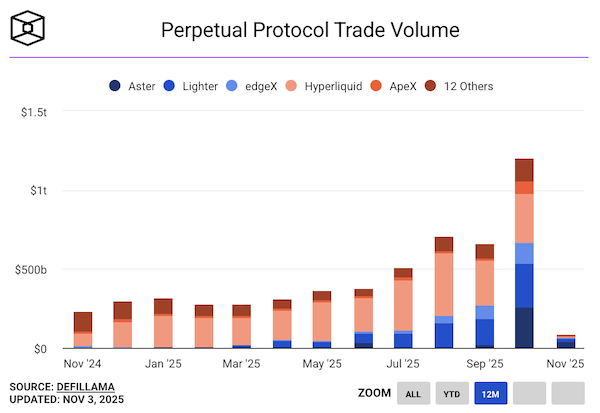
Total trading volume on DEX perpetual futures reached an all-time high of $1.2 trillion in October, almost double the previous month’s total. This boost was mainly driven by Lighter, Aster, EdgeX, Pacifica and ApeX, which all recorded record monthly volumes. Hyperliquid was the exception among the major DEX, closing the month at about 16% below its peak two months earlier, allowing Lighter to become the leading DEX perp in the market with a 27% share, while Hyperliquid’s market share dropped to 10% from 33% just a month ago.
The record DEX volumes across the board can be traced back to two main reasons: incentive programmes and the recent liquidation event. Regarding the former, almost all major DEXs are running a ‘points programme’ or similar schemes that are expected to convert to airdrops. Lighter benefits from the absence of commission maker/taker, a design that naturally attracts high frequency volumes, while Aster benefits from a direct distribution pipeline supported by BNB Chain. On the other hand, the market sell-off on 10 October forced the demobilisation of long and short positions, with settlement engines executing large-scale market orders. The consequences led to significant losses for a large number of traders, some of whom probably continued trading at higher frequencies to ‘retaliate’ and attempt to recoup their losses. Over the next one to two months, the total DEX perp volume is expected to cool off compared to October’s figures, barring further cascading liquidation events.
Polymarket sets new record: 477,000 active traders
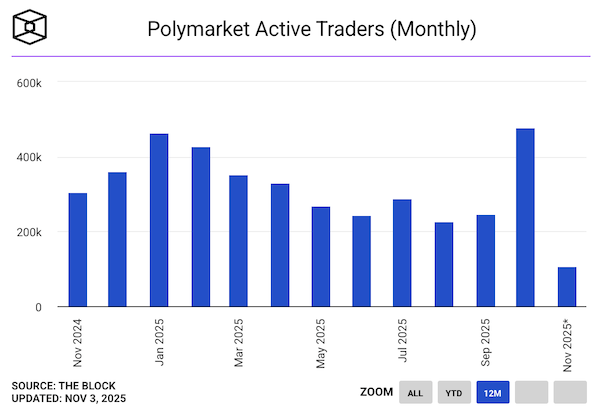
Polymarket recorded more than 477,000 active traders in October, the highest number ever recorded by the platform in a single month, up 48 per cent month-on-month from the previous period. This number even surpassed the previous US election peak of around 462,000 traders in January 2025. Both the volume traded and the number of new markets reached new record monthly highs, with the former more than doubling the previous month’s total to over $3 billion. Open interest is also up after a post-election decline, and looks set to approach previous highs.
The spike in Polymarket metrics this month was driven by the confirmation of a POLY token and airdrop, along with their imminent re-launch in the US market, as well as a potential $15bn valuation increase. These stocks not only attracted new users, but also won back inactive ones and encouraged market makers and LPs to create new markets. Kalshi also recorded record volumes with over $4.4 billion traded in October, as the prediction market category as a whole is benefiting from favourable momentum. Registered users reinforce the thesis that prediction markets are moving from niche to mainstream phenomena, generating tighter spreads, higher maximum bets, and better price discovery. The October spike looks less like an isolated event and more like a sea change for the prediction markets, with token expectations likely to keep activity high in the short to medium term.
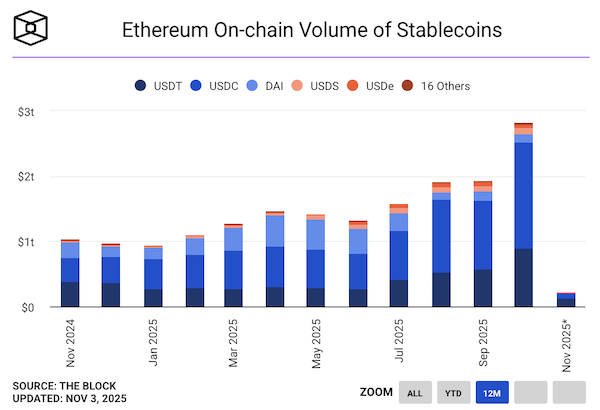
Stablecoins accelerate: $2.82 trillion in on-chain volume
On-chain stablecoin volume on Ethereum, which measures the USD value of all stablecoin transfers, was $2.82 trillion in October, representing a 31% month-on-month increase and the highest ever recorded. Growth was mainly driven by USDT and USDC, with the former surpassing USD895bn and the latter reaching USD1.62 trillion, both higher than in previous months. Other notable stablecoins such as USDe, USDS and PYUSD failed to surpass the previous month’s totals.
The increase in USDC and USDT volumes was likely driven by the continued increase in payment and payout adoptions, as more and more fintechs and marketplaces settle salaries, vendor payments and customer withdrawals in stablecoins, creating high-speed repeat flows. On-chain ‘points programmes’, RWA return programmes and restaking strategies are usually funded in USDC/USDT, generating spikes in volume as users rotate capital. In the long term, barring a policy or anchor shock, there is no reason for these parameters to slow down. On-chain stablecoin volumes are expected to continue to grow as payments to merchants and cross-border use continue to expand, although more processing may shift from Ethereum to L2, while settlement and large treasury movements will remain on Ethereum.
October 2025 was not just a record month: it was the month in which crypto proved that it had become serious infrastructure, not a passing phenomenon.